![]() |
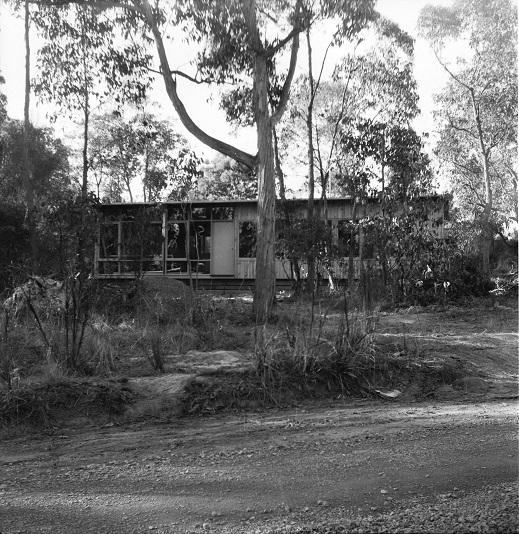
I lived at 7 Fisher Street Nunawading since 1957 when I was 4 years old. It was a very different place then, a world that was and is no longer. The streets were dusty gravel tracks in summer and pot-holed and muddy in winter when the puddles froze on frosty nights. There were remnants of the indigenous bush amongst the abandoned paddocks and orchards of the rural settlers and remaining farmers. In that bush were venomous brown snakes, blue tongue lizards, echidna, frogs, swarms of insects and choruses of native birds; there were wildflowers including orchids and sun-dews, Pink Heath, Running Postman, 'Egg and Bacon', Trigger Plants, Happy Wanderer, Maiden Hair Fern, Bracken, Sword Grass, 'Blowfly Grass'. The trees were Stringy-bark, Manna and Peppermint Gums, Tea Tree and Cootamundra, Long Leaf, Narrow Leaf and Black Wattles. It was a beautiful and natural wonderland, it felt ancient and immortal, almost sentient to the balance of it's own rhythms, tough and resilient but it was under siege and about to be swept away under a flood of humanity. My parents bought the block of land (Lot 31) for £700, they chose it for a fine Stringy-bark tree that grew at its front. Frank Fisher who was the Real Estate vendor and a First World War comrade of my Grandfather had worn a track through this block the mile to Tunstall Siding (later Nunawading Station) from his house at 327 Canterbury Road, a Californian Bungalow still standing. An early memory of mine is playing in the bush while my father was preparing the house foundations and being confronted by 'Father Christmas of the Bush' as I thought for he had a shock of white hair and red bushy eyebrows. Another memory was looking up to see my father furiously steaming towards me with an axe, I'd been playing with a baby Brown Snake and he was looking for the mother. Before we bought a refrigerator we had an icebox and once a week the Iceman would come, drape a Hessian sack on his shoulders and lump a huge block of ice to the kitchen where Mum would be waiting with the drained and open icebox, it was a real treat in summer when he gave we children shards of ice from his truck. The Harrington's Bakery delivered bread five days a week to the door in a cane basket with a horse and van, we found thistles to feed the horse. The Milkman delivered milk and cream around dawn with a Clydesdale horse that would plod the round it knew by heart, the 'Milky' would be dashing from cart to house and back with the empty bottles, it was rare to see him with reigns in hand because the horse obeyed his voice. Occasionally I would wait for the clip clop sound and rise to join them and help, they were amiable and grateful for the company. In retrospect it was an idyllic and healthy existence, not simply a rose coloured fondness for the halcyon days of childhood memories. Alas, this world was rapidly changing because in the aftermath of the Second World War a population explosion was happening, the 'Baby-Boom'; swelled by emigrants and refugees from a shattered Europe, Melbourne was expanding exponentially. More people meant more traffic and on foggy mornings cars crashed into the horses, killing and maiming them; the Dairies could no longer deliver and the Bakeries changed to Motor Vans until the Supermarkets denied them competition. Around here the Australian couples tended to retain the native vegetation, especially the trees but most of the new Australians seemed bent on eliminating this alien land, recreating formal British or European gardens instead. They destroyed the wild things and planted lawns, roses, deciduous and cypress trees; gradually over decades the glorious dawn chorus of the Australian bush faded as the native habitat dwindled to very isolated pockets and feral plants and animals invaded those. |
It continues today as each successive wave of new Australians joins a cosmopolitan society seemingly ignorant and uncaring of the native world that was pervasive here. They aspire to move into the attractive bushy suburbs then proceed to destroy the very substance of it. They will remove all 'their' Gum trees because the leaves block the gutters or they cant grow a lawn and garden under them or they might drop branches in storms then they might wonder where the Bellbirds, Honey-eaters and Kookaburra's went or why the Cicadas didn't sing this summer? The remaining Ringtail and Bushytail possums are considered a pest because they eat the fruit trees and during drought kill the stressed gumtrees by eating new growth further compounding and compromising their existence. Explaining that they were here before us just extracts mumbled words of derision.
The result of this myopic and suicidal abuse is the disaster of an homogenised, 'McFranchised' infertile urban environment ubiquitous to modern civilisation. A culture dependent upon massive mono-cultures and lethal exploitation of the surviving natural world. It's a depressing heritage of pillage and plunder driven by the greed for money that no amount of could replace even a minuscule fraction of what is destroyed. This voracious industrial consumption of Earth's natural resources is a malignant plague that will lead to biological collapse and mass extinction.
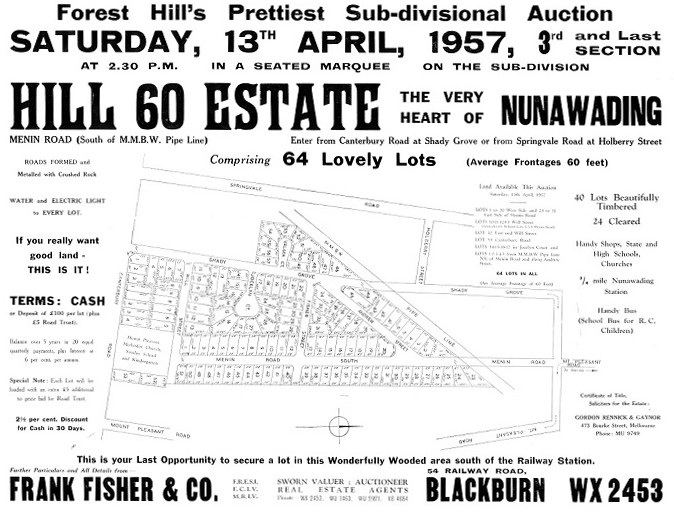
| Our neighbour of more than 40 years to the immediate east of us died in early 2008, she was the eldest child of Frank Fisher who'd named the streets in the area. There is Valma and Jocelyn Courts and Andrew Street for his children, Menin Road after that road in France to the First World War battlefield of the Somme and Shady Grove because it was; the Hill 60 Estate itself was named after a battle at Gallipoli after the Suvla Bay landings to link them with Anzac Cove. Val had two adjoining titles, one with her house upon it and a bush block that had never been tilled which was a cicada nursery and refuge for birds and possums. Val's family sold the titles individually at auction in April 2009 for nearly $900,000, we were shocked and dismayed in the early summer of 2009/10 when all the trees were destroyed on 52 Menin Road. |
![]() |
Upon enquiring at our Council as to the legitimacy of this I was told it was permitted, when I asked what was proposed to be built there I was told they didn't know because it was the business of the owner, the private surveyor and the builders! When I expressed my incredulous anger and frustration because I believe a council's primary function is to serve the ratepayers and community, not the developers I was given the names. My enquiries withhttp://www.porterdavis.com.au/(the Builder) and http://www.cbcvic.com.au/ (the Surveyor) proved dismissive, uninformative and fruitless. The retrograde changes that took the previously public assets and access and placed them in private pockets were made by the criminal Kennett Government.
The house and garage built there cover 70% of the land which is probably at the very legal limit. How it gains an energy star rating when it has no eaves to shade windows and walls baffles me. Years after completion the footpath is still broken where the power was installed and the healthy indigenous gum destroyed for the driveway crossover in the nature strip (verge) has not been replaced, in fact no trees have been planted!
The new neighbours and their philistine insensibilities demanded the destruction of our perfectly adequate 1.7 x 18 metres post and wire fence and effective screen of Wonga, Jasmine, Honeysuckle and Grape vines be replaced with a 1.9 metre wooden paling fence. We refused and were taken to Magistrates Court where the Magistrate (M. Sargent) ruled in their favour citing the changing nature of the suburb due to higher density housing even though we live in the designated SLO (Significant Landscape Overlay) 6 area overlaid for "minimal change" ! This area here has remnants of the indigenous bush and many people had retained much of it, indeed it was very attractive, so much so that it was given the Mayors Garden Awareness for Street-scapes Award in 1986 and recently granted SLO status.
The Whitehorse City Council comissioned detailed surveys of the SLO's and made them available as PDF files at the website (http://www.whitehorse.vic.gov.au/) then without notice or apology they were removed in late 2010!? This is public information paid for by our rates and taxes which re-inforced our pride in our neighbourhoods and faith that our future intentions were soundly placed. Alas the polar opposite has occurred, if that survey was carried out today I suspect the tree count would be halved and the housing density markedly increased. Titles have been divided into tiny lots and speculators have erected 'dog boxes' with minimal garden space.
This entire experience has been a series of rude transgressions prosecuted by avaricious and litigious people less than honestly using a system with more than a whiff of corruption. Was it merely coincidence that our local 'rag', The Whitehorse Leader (mostly sponsored by the 'land sharks' aka Real Estate Agents) proclaimed on the front page less than a fortnight after the court's decision "Our backyard bliss", an article about council intending to honour existing laws protecting residents from invasive developments? Was it also coincidence that the SLO 6 was made legal just after permits were granted to destroy the trees? Coincidently, it took nearly two years for the Duongs to fully comply with the court order of topping the new fence with a .5m lattice and only after threat of litigation where they would have been found in contempt of court.
When trees are removed the dynamics of wind and airflow are altered, similarly, when the land is gouged, scraped and banked it dynamically alters the flow of water. The combination of tree removal and terraforming meant that every heavy rain event produced flooding off 52 Menin Road through a point approximately 6 metres from the northern boundary from a shallow valley that had been created; we suffered substantial flooding 10 times during 12 months and never during the previous 53 years. As this flooding caused major structural damage and our pleas to remedy the situation by running a drainage trench were ignored we were forced to consider civil action under section 16 of the Victorian Water Act 1989. (They did eventually run a pipe to the stormwater along the easement to Fisher Street on the mention of litigation).
♦ ▬▬▬▬▬▬▬▬▬▬
♦